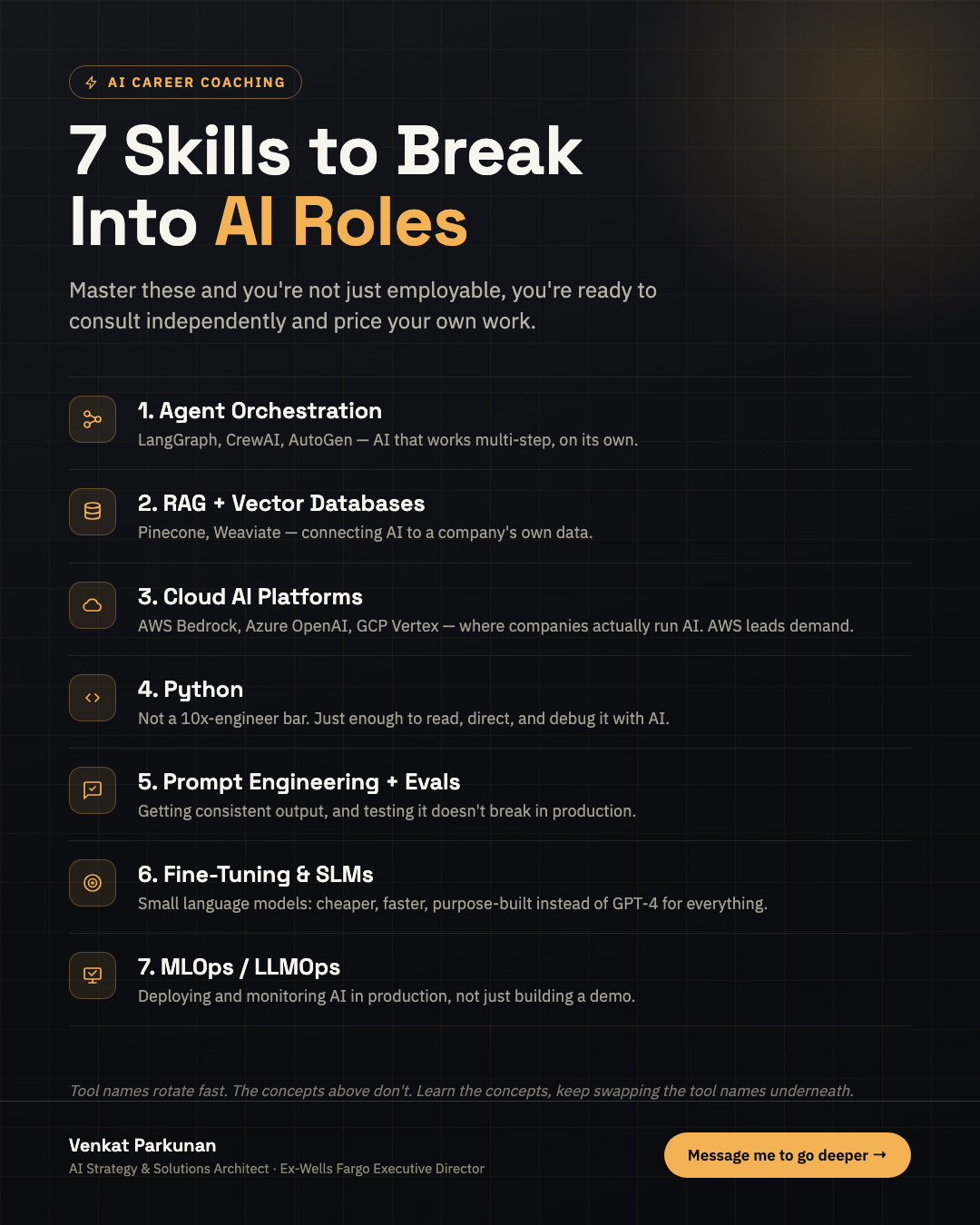
AI hiring is separating into two broad tracks: people who advance models and people who make models useful inside real organizations. Most career changers should begin with the second track. It rewards good judgment, systems thinking and the ability to ship something dependable.
Learn enough Python to build and debug, retrieval to ground answers, orchestration to coordinate steps, evaluation to measure quality, cloud deployment to operate securely, and observability to catch failures. Demonstrate those skills in one focused project.
1. Agent orchestration
Orchestration is the design of a multi-step workflow: receive a request, gather context, call tools, check constraints, produce an output and route uncertain cases to a person. Framework names will change. The durable skill is knowing when a deterministic workflow is better than a free-ranging agent.
2. Retrieval and vector search
Retrieval-augmented generation connects a model to approved company knowledge. Learn document preparation, chunking, metadata, access control, retrieval quality and citation. A strong portfolio project explains what happens when the correct source is not found.
3. Cloud AI platforms
Organizations deploy inside environments such as AWS, Azure and Google Cloud. You do not need every certification first. You do need to understand identity, secrets, logging, cost controls, data boundaries and how a prototype becomes a supported service.
4. Practical Python
Python remains the shortest path to manipulating data, calling APIs, writing evaluations and assembling a service. Aim to read unfamiliar code, isolate a defect, write a small test and explain the data flow. That is more valuable than memorizing syntax.
5. Prompt design and evaluations
A prompt is part of a system, not a magic sentence. Create a small test set with expected behavior, edge cases and unacceptable outputs. Compare changes against the same cases. This turns subjective demos into engineering work.
6. Smaller and specialized models
Learn when a smaller model, classifier or rules engine is sufficient. Cost, speed, privacy and consistency often matter more than using the largest available model. The strongest design may combine several narrow components.
7. LLMOps and production reliability
Production AI needs traces, latency and cost monitoring, version control, fallbacks, feedback capture and incident handling. A useful portfolio demonstrates how you observe the system after launch—not only how you made the happy-path demo work.
A 30-day portfolio plan
- Week 1: Pick a bounded workflow with a real user and a clear before-and-after process.
- Week 2: Build the retrieval and orchestration path, then create 20–30 evaluation cases.
- Week 3: Add human approval, logging, failure handling and a small interface.
- Week 4: Publish an architecture note, evaluation results, known limitations and a two-minute demonstration.
Frequently asked questions
Do I need to become a machine-learning researcher?
No. Applied AI roles often value problem framing, retrieval, workflow design, evaluation, deployment and communication more than original model research.
What is the best first portfolio project?
Build one bounded workflow that solves a real problem, uses a small evaluation set, documents failures and shows how a human reviews the result.
What would you build first?
Share one repetitive role or workflow you would turn into a supervised AI employee. The production forum will keep replies public, moderated and searchable.
Send your answer to Venkat